Stop Wasting Money! Why Page Quality Optimization ROI Beats Ads in the AI Search Era

Key Takeaways
- Ads solve "reach": Can buy exposure and clicks, but can't guarantee "understanding, trust, selection".
- Page quality solves "understanding and conversion": Structured answers, evidence chains, scenario coverage and experience consistency determine whether AI cites you and users place orders.
- AI search makes "zero-click + answer before click" the norm: Users first complete filtering in AI, your page quality determines if you enter the candidate set.
- Page quality is a compound asset: One optimization can long-term improve organic traffic, AI citations, conversion rates, and inversely reduce ad acquisition costs.
- Correct order: First get page quality to "AI-credible + convertible" threshold, then scale ad budgets, ROI is more stable.
1) AI search changed the growth chain: From "buying clicks" to "buying trust"
In traditional search era, users see blue links, willing to click and compare; ads' core value is "getting you seen first".
But in AI search/answer engine era, users often first ask AI: "Which is better for me?" "What evidence?" "Is it reliable?" AI first gives summaries and recommendation reasons, then decides which link to let users click (or not click).
This means: Your page isn't just a "landing page" receiving traffic, but AI and users' "evidence warehouse". Insufficient page quality makes ad-driven clicks more expensive, harder to convert, and amplifies negative reviews (high bounce, low dwell, low conversion).
2) Why "page quality" takes priority over "ad optimization"
2.1 Ads can amplify results but can't fix root causes
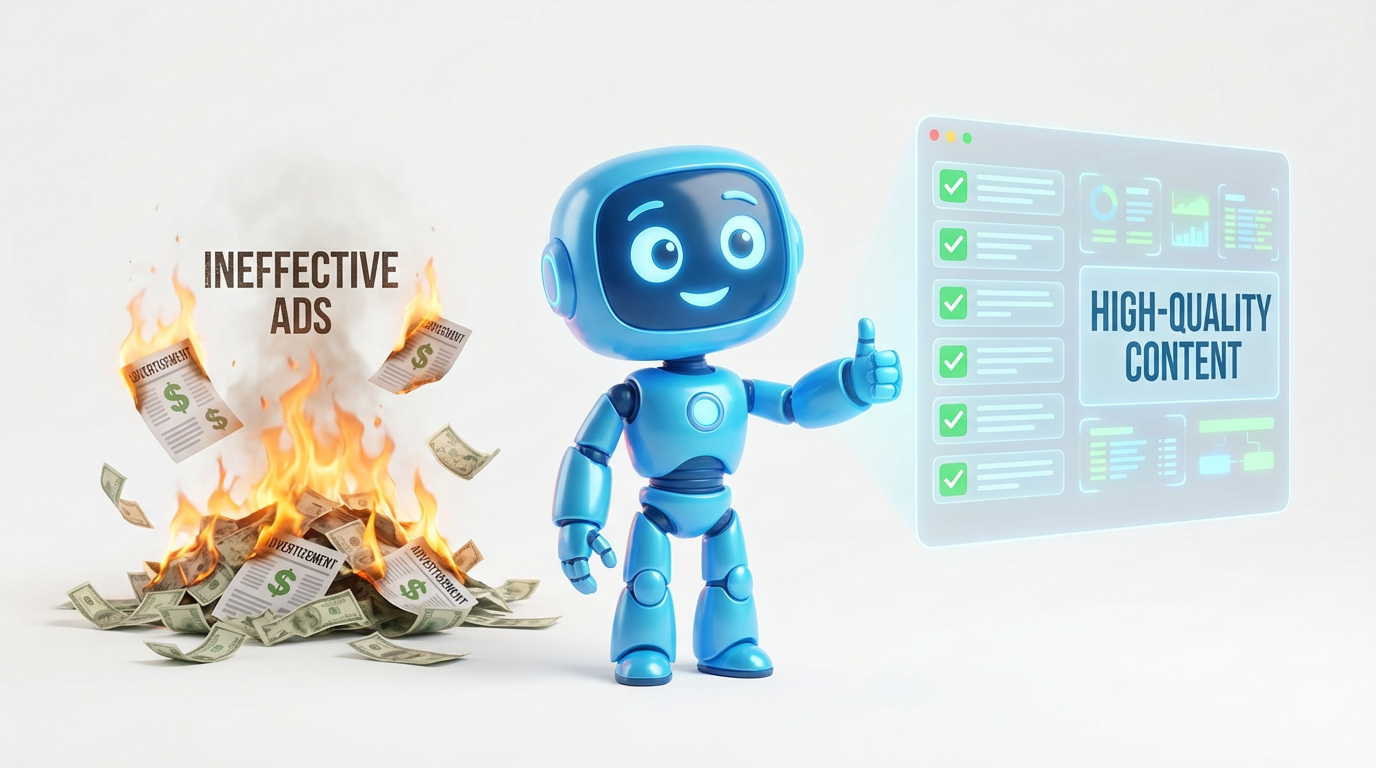
Ads excel at amplification: Double your budget, clicks may double; but if page quality causes low conversion rates, the result is faster money burning.
Think of page quality as "funnel base": Base leaks, the more water you add, the faster it leaks. Fix holes first, then add water, that's the correct growth order.
2.2 AI prefers "citable" content structures, not "pretty ad copy"
In AEO/GEO context, AI finds more credible:
- Question-answer structure: Clearly answers "who it's for/who it's not for/usage boundaries".
- Verifiable evidence expression: Parameters, tests, certifications, comparison methods, after-sales and policies.
- Consistent multi-module messaging: Title, bullet points, FAQ, image text, video scripts don't conflict.
No matter how good ad creative is, if the page can't clearly explain "why choose you" evidence, both AI and users will hesitate.
2.3 Page quality directly improves ad efficiency (CAC/ROAS)
Page quality improvements typically bring:
- Higher conversion rate (CVR): Same clicks, more orders.
- Lower bounce/longer dwell: Users more willing to read key information.
- Higher repurchase and word-of-mouth: Reduce "bought wrong" after-sales and negative review risks.
Final result: Ads aren't unnecessary, but "more worth doing". Page quality turns ads from "gambling" to "amplifier".
3) What is "AI search-friendly" page quality? (An actionable definition)
You can judge if page quality meets standards with one sentence:
Within 30 seconds, can the page let both AI and humans get: Who you are, who you're for, why, how to use, what boundaries, how to compare.
3.1 Content quality: Turn "selling points" into "answers"
- Scenario coverage: Write by user tasks, not product features (e.g., commute, gift, children's use, outdoor, sensitive skin/allergy-prone, etc.).
- Comparison expression: How do you win at same price? What's different from mainstream alternatives? Don't just say "better".
- Clear boundaries: Who it's not for, usage limitations, parameter thresholds actually build more trust.
3.2 Evidence chain: Make AI "dare to cite", make users "dare to buy"
- Verifiable numbers: Dimensions, weight, materials, power, battery life, error range, compatible models.
- Authoritative backing: Certifications, tests, standards, media/institution citations (with sources better).
- Risks and guarantees: Warranty, returns, customer service response, compliance statements.
3.3 Structure: Make "information machine-readable"
- FAQ/Q&A blocks: Cover high-intent questions (comparison/concerns/after-sales/compliance/usage scenarios).
- Clear hierarchical headings: H2/H3 chunk information, avoid long paragraph stacking.
- Tables/checklists: Parameters and comparison points in tables are easiest to cite.
3.4 Experience and consistency: Make "read then order"
- Above-fold conclusion: One-sentence positioning + 3-5 key points.
- Multimodal consistency: Text on images matches page copy (especially key parameters and promises).
- Performance foundation: Slow page load, blurry images, hard-to-find information significantly lower conversion.
4) A practical priority: First get "page quality" to threshold, then optimize ads
Suggest "three-stage" resource allocation:
- P0 (Do first): Change page to "can answer questions + has evidence + has structure". This is the minimum threshold for AI credibility and conversion.
- P1 (Do next): Complete key scenario library and comparison points, solve "why choose you" decision reasons.
- P2 (Scale): Only after page has stable conversion, put more effort into creative, campaign structure and bidding optimization.
This isn't "content over ads", but "first make conversion base solid, then let ads better amplify".
5) 7-day implementation checklist: Make page quality a reusable standard
Day 1-2: Extract "high-intent questions"
- List 20 most-asked user questions (scenarios/comparison/concerns/parameter thresholds/after-sales).
- Map questions to page modules: Above-fold, bullet points, FAQ, image copy, video scripts.
Day 3-4: Complete evidence chain and boundaries
- Rewrite "claims" into "claim + evidence + conditions" (e.g., under what conditions it holds).
- Add 1 parameter table + 1 comparison table (vs alternatives/competitors).
Day 5-6: Structural reorganization (make AI read better)
- Use H2/H3 to chunk content, avoid long paragraphs.
- FAQ covers TOP 10 high-intent questions, with short citable answers.
Day 7: Consistency check + small traffic validation
- Check if title/bullet points/FAQ/image text have same messaging, if there are conflicts.
- Run small budget for 48 hours, observe CVR, bounce, dwell, inquiry/cart changes, then decide whether to scale.
6) FAQ
Q1: Can I test with ads first?
Yes, but suggest small budget for "diagnosis", don't use large budget to "force push". Ad clicks are expensive test samples, first make page quality convertible, test costs will be lower.
Q2: If page quality is very good, do I still need ads?
Yes. Page quality determines your "conversion ceiling" and "AI visibility", ads determine if you can scale faster. Correct relationship: Page quality is the base, ads are the accelerator.
Q3: How to judge if page quality meets standards?
Watch two signal types: One is user signals (bounce down, dwell up, CVR up); Two is AI signals (citation/recommendation frequency up, long-tail scenario questions more likely to feature your brand/page).